Pintxos vs. tapas: what’s the difference?
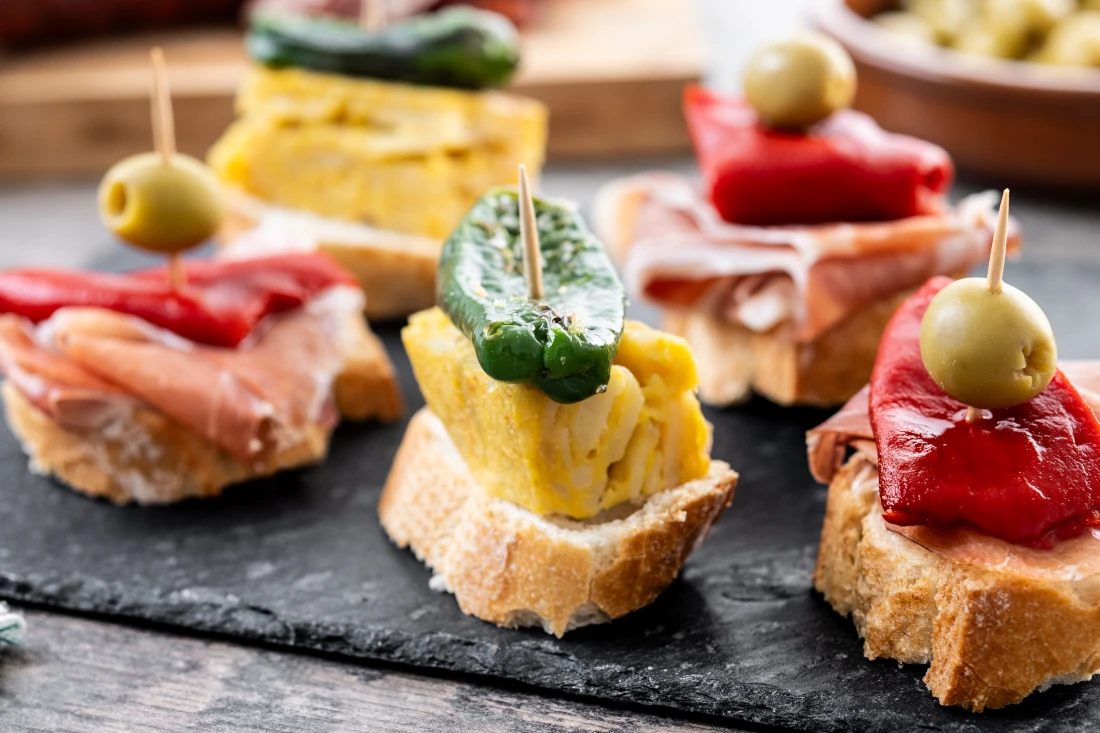
Some culinary questions seem simple until you find yourself standing in front of a bar counter filled with tempting small bites. Pintxos or tapas? Although both are part of Spanish food culture and share the idea of enjoying small dishes in good company, they are not exactly the same.
In simple terms, a pintxo is a small bite closely associated with Basque culinary tradition, while a tapa is a broader concept covering small portions served in bars throughout Spain. However, there is no strict dividing line between the two: they may be similar in size, ingredients and even level of preparation.
The main difference, therefore, lies in their origins, their evolution and the food culture that surrounds them.
What is a pintxo?
The pintxo is one of the great symbols of Basque food culture, with the tradition of pinchos also deeply rooted in neighbouring Navarre.
Its name is linked to the traditional way these small bites were served: on a slice of bread and, in many cases, held together with a cocktail stick. Over time, however, the concept has evolved, and today neither bread nor the stick is essential.
What remains is the idea of a small dish designed to be enjoyed in one or just a few bites.
From simple and instantly recognisable classics such as the gilda to genuine examples of miniature cuisine, pintxos can combine meat, fish, vegetables, cheese, sauces and seasonal ingredients.
Pintxo culture has also evolved particularly strongly in the Basque Country towards increasingly creative creations, where technique, quality ingredients and presentation all play an important role.
And what is a tapa?
A tapa is a much broader concept and can be found, in many different forms, throughout virtually all of Spain.
Traditionally, it is a small portion of food served alongside a drink, although today the term covers a huge variety of dishes depending on the region and the establishment.
A tapa can be as simple as olives, potatoes or a portion of cheese, but it can also be a much more elaborate creation.
It is precisely this regional diversity that makes tapas culture so rich: every part of Spain has developed its own recipes, customs and ways of enjoying them.
Pintxos vs. tapas: the main differences
So, what really is the difference between pintxos and tapas?
Origin: pintxos are particularly associated with the food culture of the Basque Country, while tapas form part of a tradition found throughout Spain.
Format: a pintxo is usually conceived as an individual bite or small dish. Traditionally, many were served on bread and held together with a cocktail stick, although today the format is far more flexible.
Preparation: there is no rule stating that a pintxo must be more elaborate than a tapa. However, Basque pintxo culture has developed a particularly strong tradition of miniature cuisine, with increasingly creative and sophisticated dishes.
Presentation: pintxos may be served on bread, on skewers, in small dishes or using more elaborate presentations. Tapas can be equally varied depending on the region and the establishment.
Food culture: both tapas and pintxos are connected to a social way of eating and drinking. In the Basque Country, however, going from bar to bar for pintxos is a particularly deeply rooted tradition, closely associated with customs such as txikiteo.
Rather than competing with one another, pintxos and tapas represent two ways of enjoying something they very much have in common: eating well, discovering different flavours and sharing a table or bar counter in good company.
Pintxo tradition comes to Palma
You do not have to travel to San Sebastián or Bilbao to experience this way of enjoying food.
At La Vasca, in the centre of Palma, pintxos play a central role in a culinary concept inspired by the cuisine and food traditions of northern Spain.
From a classic gilda to the restaurant’s own selection of pintxos, the aim is to bring some of that bar culture to Mallorca through small bites, quality ingredients and dishes designed for sharing.
It is an informal way to discover the flavours of Basque cuisine, try different dishes and turn lunch or dinner into a journey through a variety of tastes and creations.
Because ultimately, perhaps the real difference between pintxos and tapas lies not only in the way they are prepared or presented, but also in everything that happens around them: a bar counter, a drink, good company and one bite that makes you want to order another.
And that, whether in the Basque Country or at La Vasca, remains a very good way to eat.